
Screens and Education:
How They Are Used Matters More Than How Much They Are Used
For years, the debate about the relationship between young people and technology has been framed almost exclusively in terms of time: How many hours of screen time are too many? However, this question is based on a problematic oversimplification. Not all screen-based activities are equivalent or have the same effects.
27 de mayo de 2024
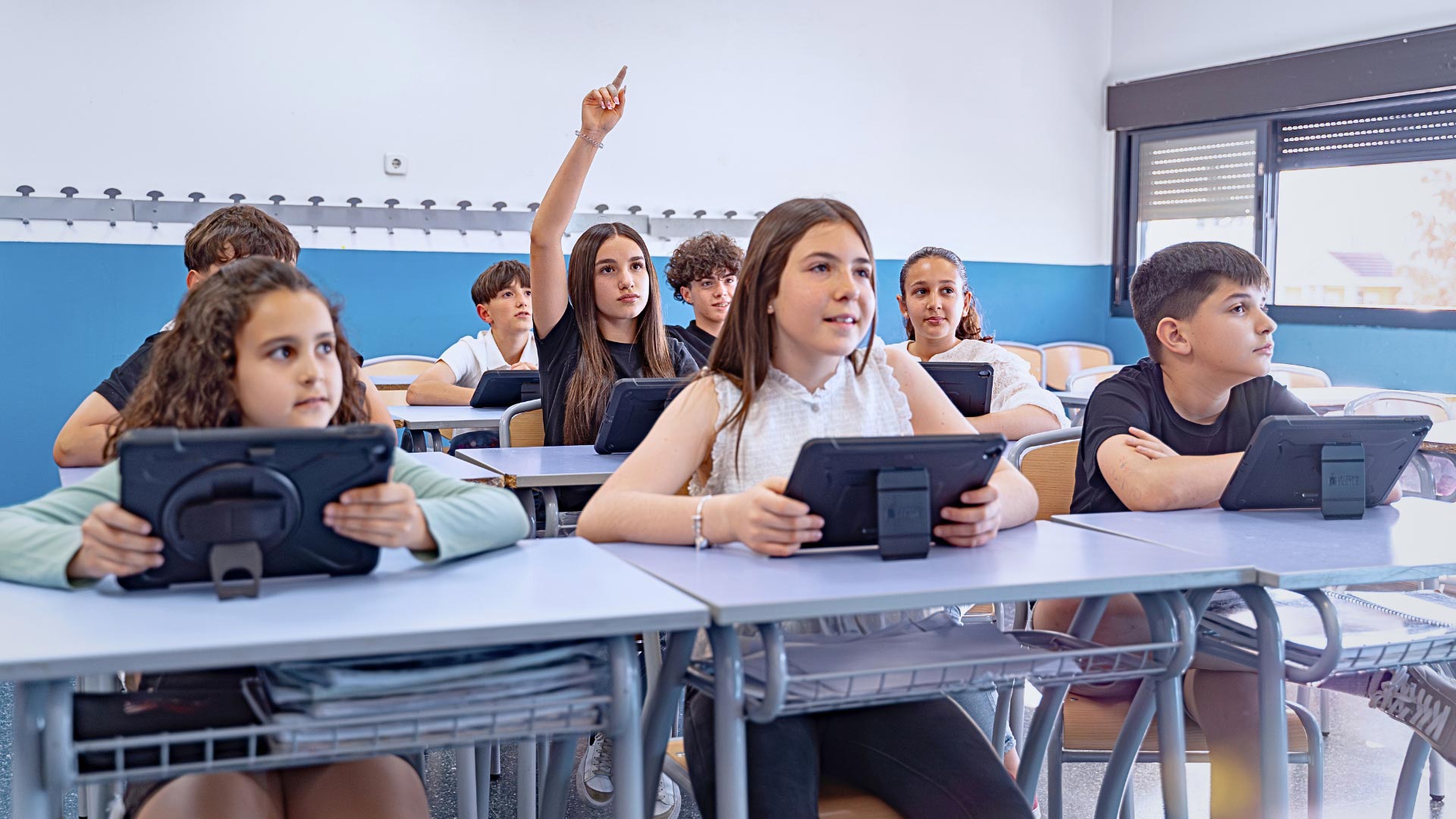
The American Academy of Pediatrics (AAP) advocates moving beyond a view based solely on the number of hours and analyzing the intentional use of digital media within a broader context. Its current approach recognizes that technology can have both benefits and drawbacks, and that its effects depend on the quality of the content, the design of the applications, the characteristics of the child, and the family and social environment.
Screen Use in Secondary Education: Not All Screen Time Is the Same
Spending thirty minutes talking to a family member over a video call, completing an educational activity, or watching short videos through autoplay involves completely different cognitive and social experiences, even when the amount of time and the device are the same.
For this reason, the AAP recommends paying attention to several factors:
- Content quality: What the child watches or does and whether the content is appropriate for their age and developmental stage.
- Context of use: When, where, and for what purpose technology is used.
- Interaction: Whether the use is passive or promotes participation, conversation, and creation.
- Co-viewing: Especially among younger children, having an adult present can help them interpret what they see and apply what they learn to other situations.
- What it displaces: Whether digital use interferes with sleep, physical activity, relationships, reading, play, or any other necessary experience.
This last criterion is known as crowding out and refers to the fact that what matters is not only how much time a technology takes up, but also what other activities it displaces. The AAP itself points out that measuring minutes or hours provides insufficient information unless we also consider the nature of the activity and which activities are being given up as a result.

Technology in the Classroom: What Is Its True Educational Value?
In education, this approach requires us to consider a particularly relevant question: Does technology provide value that nontechnological alternatives do not, or cannot provide in the same way?
A digital activity may allow students to manipulate variables, observe processes that are difficult to reproduce in the classroom, receive immediate feedback, test hypotheses, or represent complex phenomena. In these cases, the screen is not the educational activity itself; it is the medium through which a particular learning experience takes place.
Therefore, using an application designed to encourage rapid, continuous consumption—as is the case with some social media platforms, for example—is not equivalent to working with an educational resource that requires students to observe, reason, make decisions, and construct explanations. The device may be the same, but the cognitive design of the experience is not.
How to Identify the Real Risks of Screen Use Among Children and Adolescents
Moving beyond the idea that all screen exposure is harmful does not mean ignoring its potential risks. Problems usually arise when:
- digital use interferes with sleep, physical activity, or personal relationships;
- the content is inappropriate for the child’s age;
- the experience is predominantly passive;
- technology becomes the only strategy for calming distress;
- there is no adult support or conversation;
- the design is intended to prolong use through autoplay, constant stimulation, advertising, or manipulative design patterns.
The AAP explicitly warns about designs intended to capture and retain attention and distinguishes them from those designed around children’s needs, safety, and development.
Keys to Healthy Digital Habits
The AAP’s recommendations do not call for abandoning limits. Rather, they encourage setting meaningful limits that take into account each child’s age, development, and circumstances. They also recommend favoring high-quality content, sharing some digital experiences, talking about them, and preventing devices from interfering with sleep and family life.
The issue, therefore, cannot be reduced to choosing between “screens” and “no screens.”
When evaluating technology, time matters, but so does—and especially so—what we do with it, how we use it, with whom, and for what purpose. Understanding this distinction makes it possible to protect children and adolescents from problematic uses without giving up the educational potential of well-designed digital resources.
The American Academy of Pediatrics guide is available here: Beyond Screen Time: A Parent’s Guide to Media Use


The International Science Teaching Foundation (ISTF) is a non-profit organization committed to improving STEM education, headquartered in London and Barcelona. The ISTF is formed by more than 30 scientists, educators and experts who work tirelessly to improve science teaching worldwide. Its mission is to foster an international community of STEM educators with an active dedication and commitment.







Leave a Reply