
Eclipses
Understanding One of the Most Remarkable Phenomena in the Solar System
Eclipses are phenomena caused by the relative positions and motions of Earth, the Moon, and the Sun. Although they occur with predictable regularity, they were interpreted for centuries as supernatural signs. Understanding how these three celestial bodies interact helps explain one of the most spectacular sights that can be observed from Earth.
4 de diciembre de 2024
The sudden disappearance of the Sun in broad daylight or the gradual darkening of the Moon has fascinated and puzzled human societies since ancient times. For centuries, eclipses were seen as omens, divine manifestations, or extraordinary events capable of changing the course of history.
Today, we know that these phenomena have a precise scientific explanation. Eclipses occur when Earth, the Moon, and the Sun align. These three celestial bodies are in constant motion, and their relative positions determine when and how eclipses take place.
Although they may seem rare or exceptional, eclipses follow the same physical laws that govern the rest of the solar system. Understanding why they occur reveals how the geometry and motion of celestial bodies give rise to some of the most spectacular events visible from our planet.
When Three Celestial Bodies Align
The word eclipse comes from the Greek ékleipsis, meaning “abandonment” or “disappearance.” For centuries, people experienced eclipses exactly that way—as if the Sun or the Moon had suddenly vanished. Many ancient cultures interpreted them as divine signs, warnings of disaster, or messages from the supernatural. Today, we know that there is nothing mysterious about them. Eclipses are the result of a precise alignment among Earth, the Moon, and the Sun, providing one of the clearest examples of how the geometry of the solar system becomes visible from our planet.
Why Don’t Eclipses Happen Every Month?
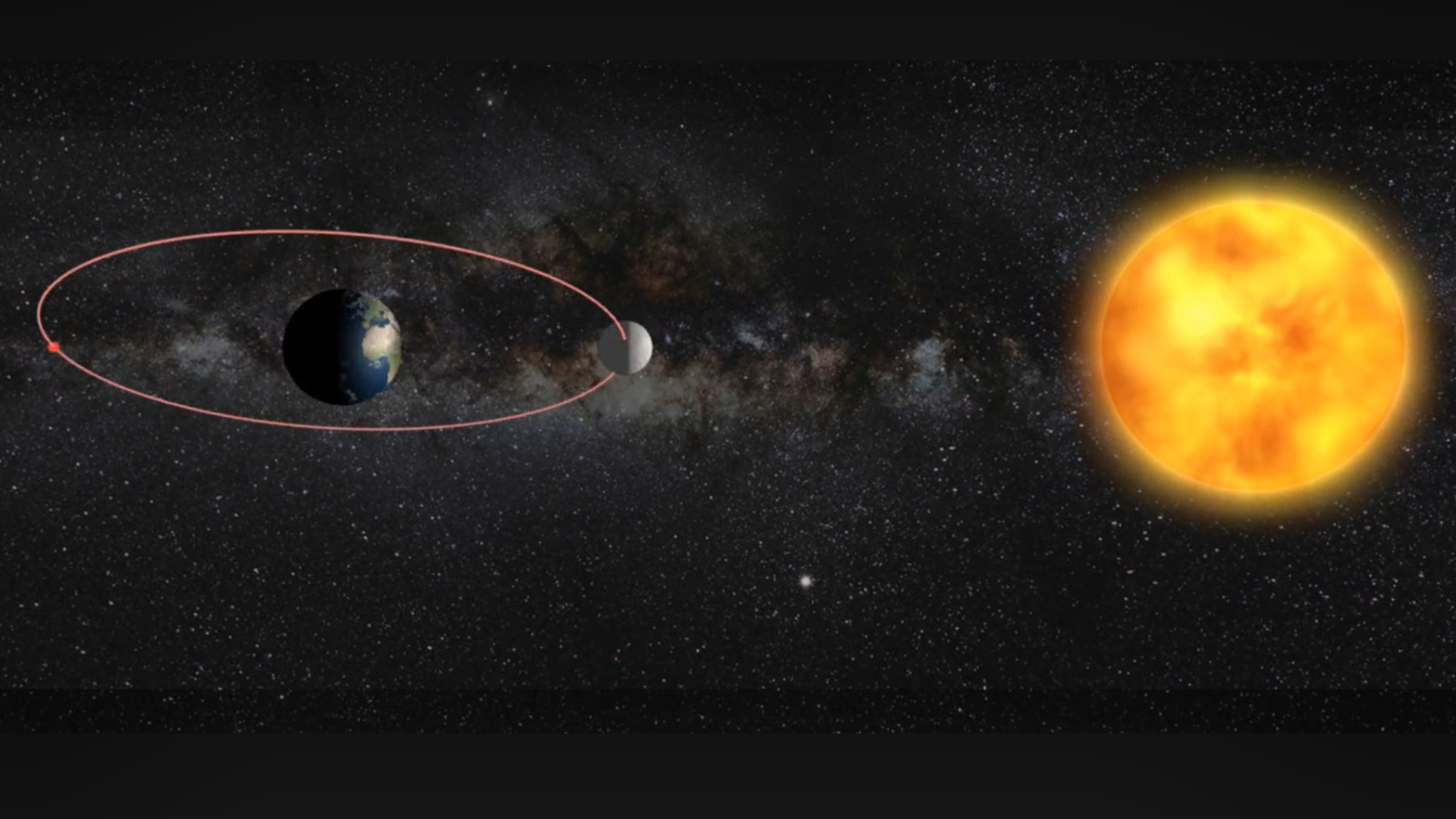
If the Moon orbits Earth once every month, shouldn’t eclipses occur all the time? The answer is no. The plane of the Moon’s orbit is tilted by about 5 degrees relative to Earth’s orbital plane around the Sun, known as the ecliptic plane. Eclipses occur only when the Moon crosses this plane at specific points, called nodes, at precisely the right moment for the three bodies to align.
Video from “The Solar System” unit provided by Science Bits, which shows when and how the Moon’s orbit and the ecliptic match at points called nodes. On average, this happens four times a year.
Science Bits is the science education project designed based on research on how people learn.
Types of Eclipses on Earth
As we can see in the previous video, there are two main types of eclipses: solar eclipses and lunar eclipses. In both cases, the phenomenon results from an alignment among Earth, the Moon, and the Sun, although the position occupied by each body is different.
Solar Eclipses
Solar eclipses occur when the Moon passes between the Sun and Earth, casting its shadow on part of our planet. They can take place only during the new moon phase.
Depending on how much of the Sun is obscured, three main types of solar eclipses can occur:
Total solar eclipse. In a total solar eclipse, the Moon completely covers the Sun’s disk. Observers located within the umbra, the darkest part of the Moon’s shadow, experience a brief period of darkness and can see the solar corona, the outermost layer of the Sun’s atmosphere. A total solar eclipse is one of the most spectacular astronomical events that can be observed from Earth.
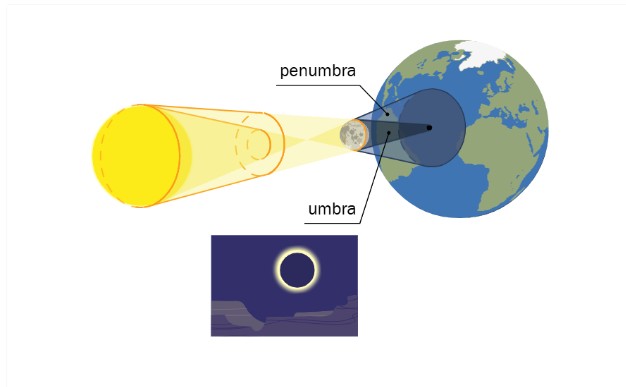
The Sun-Earth-Moon System in a total solar eclipse.
Partial solar eclipse. A partial solar eclipse occurs when the alignment is not perfect or when the observer is located in the penumbra, the lighter outer region of the Moon’s shadow. Only part of the Sun is hidden, giving it the appearance of having a distinctive “bite” taken out of it. This is the most common type of solar eclipse.
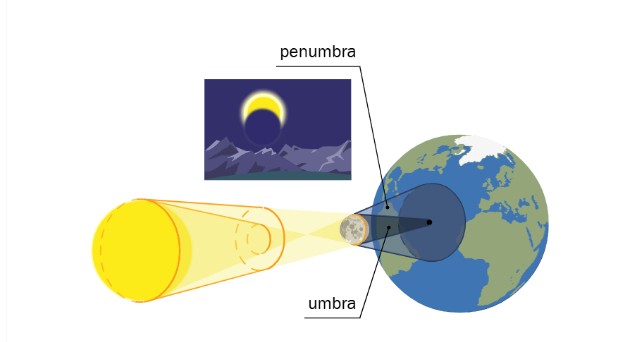
The Sun-Earth-Moon System in a partial solar eclipse.
Annular solar eclipse. The Moon’s orbit around Earth is not perfectly circular. At times, the Moon is farther away from Earth and appears slightly smaller in the sky.When this happens, it cannot completely cover the Sun during an eclipse. Instead, a bright ring of sunlight remains visible around the Moon. This striking phenomenon is popularly known as the “ring of fire.”
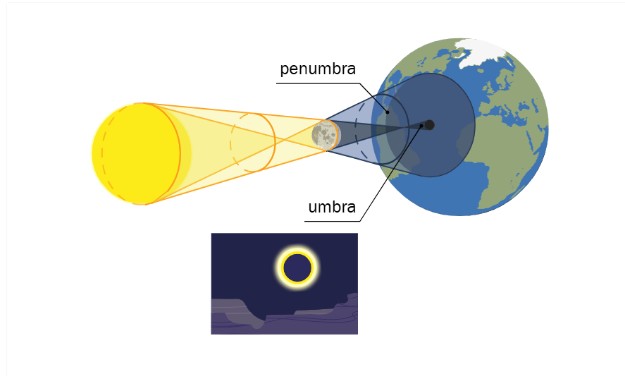
The Sun-Earth-Moon System in a annular solar eclipse.
Lunar Eclipses
Lunar eclipses occur when Earth passes between the Sun and the Moon, casting its shadow on the lunar surface. They can take place only during the full moon phase.
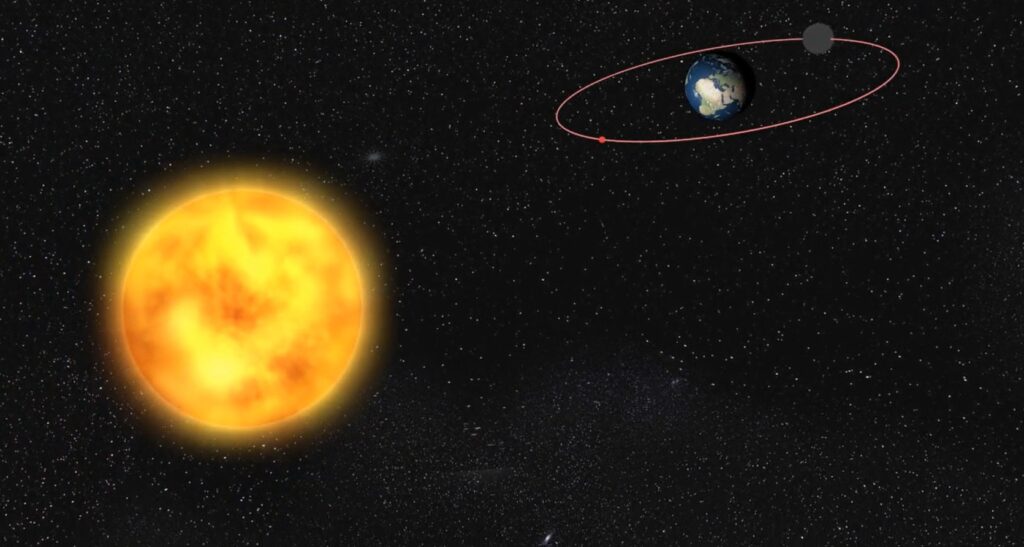
Depending on which part of Earth’s shadow the Moon passes through, three types of lunar eclipses can occur:
Total Lunar Eclipse. A total lunar eclipse occurs when the Moon moves completely into the umbra, the darkest part of Earth’s shadow. During totality, the Moon does not disappear entirely. Instead, it usually takes on a reddish color due to the refraction of sunlight through Earth’s atmosphere, which is why it is sometimes called a “blood moon.”
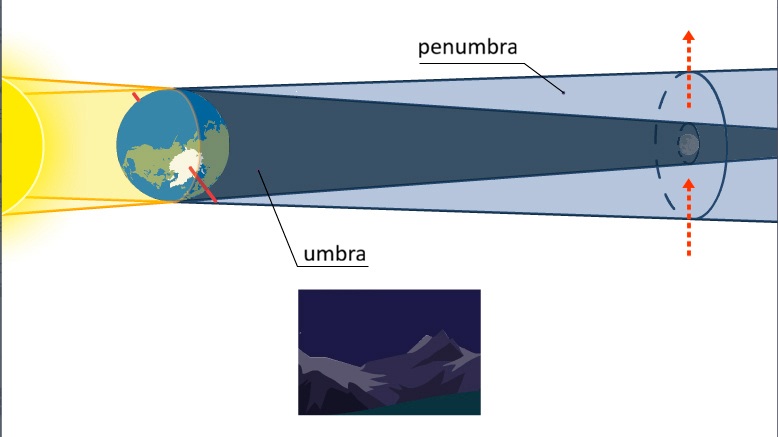
The Sun-Earth-Moon System in a total lunar eclipse. The pointer indicates the Moon’s path during the total eclipse.
Partial Lunar Eclipse. In a partial lunar eclipse, only part of the Moon enters Earth’s umbra. As a result, one portion of the lunar disk appears darkened while the rest remains illuminated.
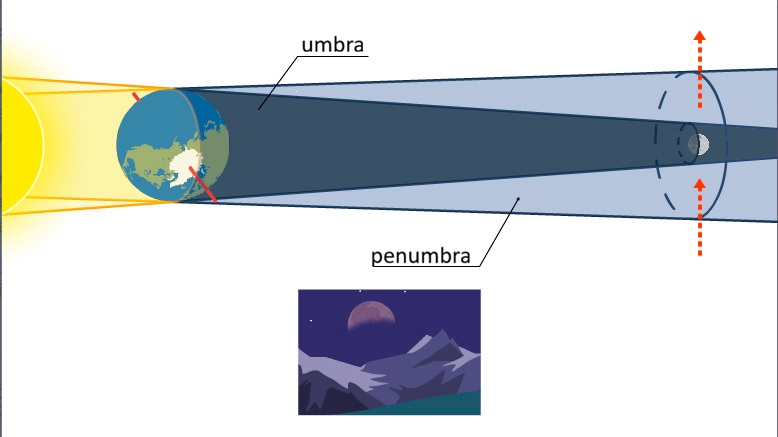
The Sun-Earth-Moon System in a partial lunar eclipse. The pointer indicates the Moon’s path during the partial eclipse.
Penumbral Lunar Eclipse. A penumbral lunar eclipse occurs when the Moon passes only through Earth’s penumbra, where sunlight is blocked only partially. The resulting dimming is very subtle and can sometimes be difficult to notice with the naked eye.
Unlike solar eclipses, which are visible only from a narrow path on Earth’s surface, lunar eclipses can be seen from anywhere on the night side of the planet. This means that millions of people can observe the same lunar eclipse at the same time.
Science Spotlight: The Trick of Apparent Sizes
There is a remarkable coincidence in our solar system. Although the Sun is about 400 times larger than the Moon, it is also about 400 times farther away from Earth. As a result, the two objects appear to be almost exactly the same size in our sky, making total solar eclipses possible.
However, this coincidence has not always existed—and it will not last forever.
The Moon is moving away from Earth at a rate of about 3.8 centimeters per year. Hundreds of millions of years from now, its apparent size will be too small to completely cover the Sun, and total solar eclipses will no longer occur. Human beings therefore live during a unique period in our planet’s history: one in which our Moon and our star appear to fit together almost perfectly in the sky.
If you would like to learn more about eclipses visible from Spain in 2026, 2027 and 2028, the Ministry has created the website eclipses.ign.es, ith the official astronomical information offered by the National Geographic Institute and following the calculations performed by the National Astronomical Observatory.
Would You Like to Explore These Topics in the Classroom?
This article was produced in collaboration with Science Bits, the educational materials developed by the project served as the basis for both this article and a selection of classroom activities on eclipses.
Teachers who would like to receive these resources can simply complete the form below and will receive an email with the materials.
*Having trouble with the form? Please contact us [email protected]
WRITTEN BY Lucas Ubach
Pictures & Illustrations credits
- The Sun-Earth-Moon System in a total solar eclipse – “The Solar System” Science Bits’ unit.
- The Sun-Earth-Moon System in a parcial solar eclipse – “The Solar System” Science Bits’ unit.
- The Sun-Earth-Moon System in a annular solar eclipse – “The Solar System” Science Bits’ unit.
- Lunar eclipse and the ecliptic plane – “The Solar System” Science Bits’ unit.
- The Sun-Earth-Moon System in a total lunar eclipse – “The Solar System” Science Bits’ unit.
- The Sun-Earth-Moon System in a partial lunar eclipse – “The Solar System” Science Bits’ unit.






Leave a Reply