
Crime Scene Evidence
Discover in this article how genetic engineering can be a great ally in uncovering the facts of a specific event.
22 de mayo de 2024

Genetic Engineering to Uncover the Facts
We all know that DNA analysis is useful for identifying criminals who have made the mistake of leaving a sample of their body (skin, hair, saliva, etc.) at a crime scene. DNA analysis is also widely used in paternity testing, which determines whether a man is the biological father of a child. More generally, DNA analysis can be used to establish biological relationships between people, since close relatives share many fragments of their genetic material and therefore tend to resemble one another physically (and psychologically).
🧬DNA = ID
Each of us is unique. This is also true at the genetic level, except in the case of monozygotic twins, who are genetically identical. Even so, genes do not have the final say—rather, they have the first—and environmental factors mean that twins eventually become unique individuals as well, even before birth. Setting aside the exception of identical twins, each person has a unique DNA profile.
This is because there are different versions of genes (and other elements) that make up our DNA, so each person has a different combination. Even siblings have different genetic material, because sexual reproduction allows for an almost infinite number of DNA combinations by mixing the mother’s and father’s DNA. In this way, our DNA functions like a personal identification document that we leave behind, often without realizing it, wherever we go.
Hair, saliva, flakes of skin… even a single eyelash can serve as a calling card wherever we pass.
What Does DNA Identification Testing Involve?
DNA is like a personal ID, but it is longer than an encyclopedia. Fortunately, we do not need to read all of it to determine who it belongs to—that would take far too long. Instead, it is enough to analyze a specific combination of very short fragments in order to assign them to a particular individual.
However, it is essential to have a set of “suspects” for comparison. A suspect might be a possible criminal whose presence at a crime scene is being investigated, or a presumed father whose biological relationship to a child is being tested. If the comparison between the DNA fragments (genetic markers) from the reference sample and the unknown sample shows a match, it is very likely—though not obvious and certainly not 100 percent certain—that the suspect is “guilty.”
Before these small DNA fragments can be analyzed, especially when the sample is tiny or contains very little DNA (a hair, an eyelash, and so on), they must be amplified. In other words, many copies of these DNA fragments must be produced so that sequencing is possible. This is done using a technique that became widely known during the COVID-19 pandemic in 2020: the polymerase chain reaction, more commonly called PCR.

Only 0.1 percent of our genome makes us different from other humans, but because the genome is extremely long (it contains about 3.2 billion characters), that 0.1 percent includes many differences!
🕵️ Serving Criminology
In 1986, DNA analysis was used for the first time to solve a crime: the murder of two girls in Leicestershire, England. Since then, forensic techniques have improved greatly. Among other advances, DNA amplification using PCR has made it possible to work with very small samples. This has allowed so-called cold cases—cases that had remained unsolved because of a lack of evidence—to be reopened and investigated using modern forensic methods. Some of these cases date back to the 1950s or even earlier. With today’s techniques, it is even possible to predict a suspect’s hair color or certain facial features.
For DNA to be successfully extracted from biological traces—which are often small and fragile—the collection, storage, and transport of samples must be carried out with extreme care. If the forensic examiner is not aware of this, the evidence may be lost, degraded, or contaminated, and any investigation that might have provided information about a crime will be invalidated.

Predicting a Criminal’s Last Name
A team of researchers in the United Kingdom developed a technique that makes it possible to predict the last name of the person who left a DNA sample at a crime scene. How is this done? Last names, like the Y chromosome, have historically been passed down from fathers to sons. As a result, people who share the same last name often share a common Y-chromosome lineage.
A team of researchers in the United Kingdom developed a technique that makes it possible to predict the last name of the person who left a DNA sample at a crime scene. How is this done? Last names, like the Y chromosome, have historically been passed down from fathers to sons. As a result, people who share the same last name often share a common Y-chromosome lineage.

🧬Ancient DNA
Paternity tests are relatively common today. But what if we wanted to know whether a person from the past is related to us? Is that possible?
The limiting factor is ancient DNA. Obtaining DNA in good condition from two living individuals is relatively easy. The situation becomes much more complicated when DNA must be extracted from ancient samples that have degraded over time, as is typical of human remains. And the challenge is even greater when dealing with DNA from prehistoric ancestors. For this reason, specialized techniques must be developed to extract and analyze ancient DNA.
Ancient DNA is usually found in a very deteriorated state in bones and teeth, which makes extraction extremely difficult. If conditions are favorable, some soft tissue may still be preserved, containing more DNA and allowing for easier extraction. In general, the older the sample, the less likely it is that intact DNA will remain. Of course, much depends on the conditions under which the body was preserved.

🦕Is It Possible to Create a Jurassic Park?
So, can we obtain DNA from ancient samples—samples as ancient as, say, a dinosaur? Can we clone dinosaurs? For now, the idea popularized by the films Jurassic Park and Jurassic World is completely impossible. In fact, we do not have a single sample that has been preserved well enough—over more than 65 million years!—to allow even one dinosaur gene to be read, let alone an entire genome.
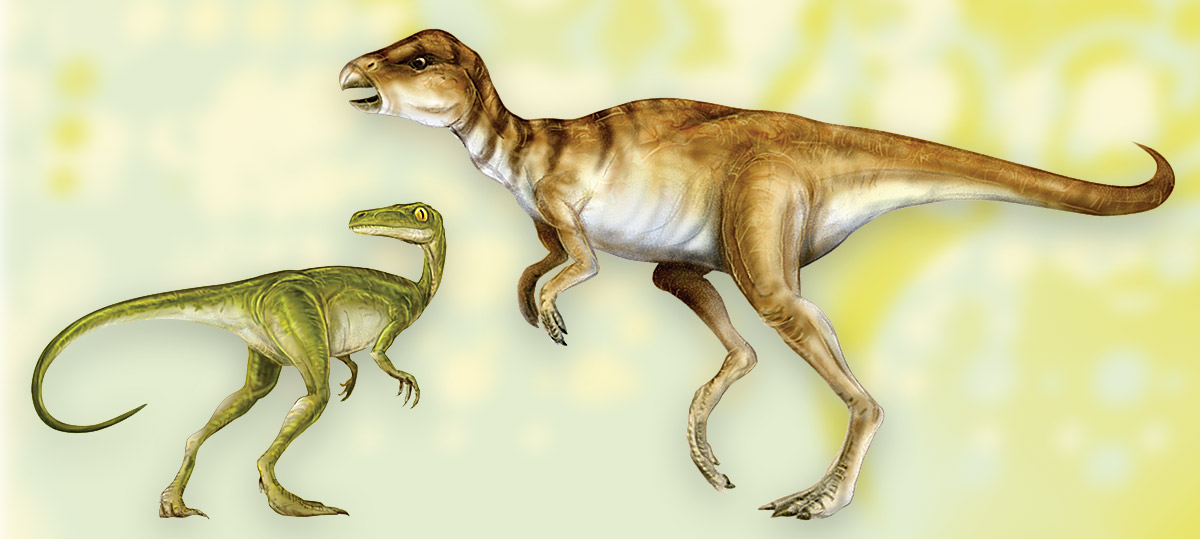
By contrast, it has been possible to recover and analyze genes from mammoths. Specifically, the Catalan researcher Carles Lalueza-Fox, a leading international expert in ancient DNA, managed to extract DNA from mammoth remains preserved in Siberian ice for 43,000 years. From the fragments obtained, researchers identified a gene essential for hair pigmentation in mammals. By analyzing this gene, scientists were able to determine the hair color of these enormous animals. Interestingly, the creators of the animated film Ice Age 2 were right to depict some mammoths with dark fur and others with lighter or reddish fur.
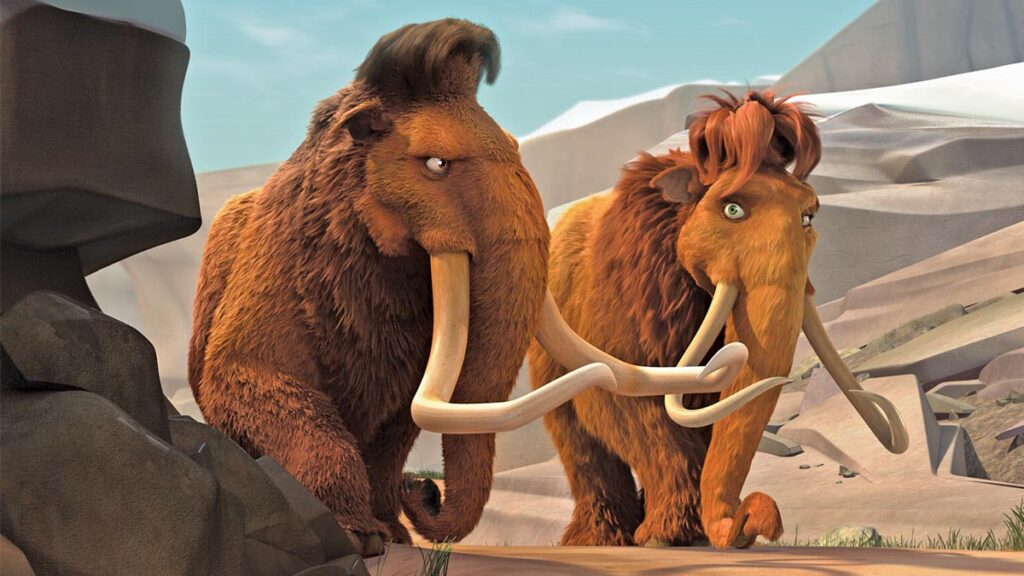
The analysis of ancient mammoth DNA has allowed scientists to determine what color those animals were.
🧬 Two Types of DNA
Each of our cells contains a copy of our DNA. However, there are two types of DNA found in cells: nuclear DNA and mitochondrial DNA. Nuclear DNA, broadly speaking, determines our traits and is located in the cell nucleus. There is only one copy of nuclear DNA in each cell. Mitochondrial DNA, by contrast, is found inside mitochondria—cell structures responsible for producing energy from the oxygen we breathe.
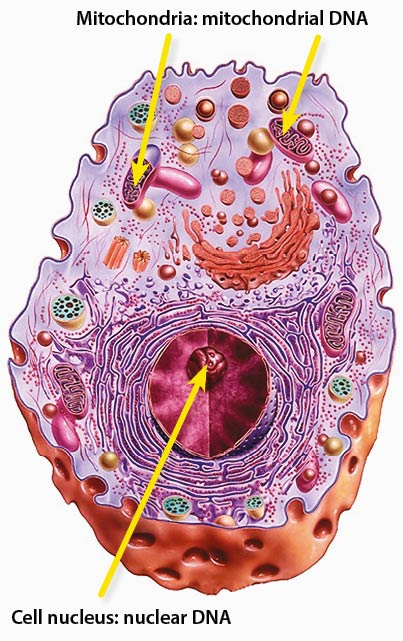
Mitochondria have their own DNA and multiply inside cells because, millions of years ago, before animal cells existed, mitochondria were free-living bacteria in the environment. Almost all our cells contain mitochondria (red blood cells are an exception). Unlike nuclear DNA, which we inherit equally from our father and our mother, mitochondrial DNA is inherited only from the mother. This is because, at fertilization, the sperm contributes only its head, which contains nuclear DNA, and does not provide mitochondria. All the mitochondria in our bodies are descendants of those originally present in our mother’s egg cell.
Mitochondrial DNA is especially useful for studying ancient samples because there are thousands of copies per cell (one in each mitochondrion). In addition, because it does not include genetic information from the father, it avoids complications related to possible non-biological paternity. This type of direct inheritance—without mixing DNA from the mother and the father, that is, without recombination—means that mitochondrial DNA is passed down in a highly conserved way from mothers to their children. As a result, it is possible to identify remains even when the reference sample and the evidence sample are separated by several generations.
UAB Scientists Identify Civil War Mass Grave Victims Using Mitochondrial DNA
The Genetic Identification Group at the Autonomous University of Barcelona (UAB) developed a basic methodology for the genetic analysis of ancient human remains using mitochondrial DNA and applied it to bodies recovered from several mass graves dating from the Spanish Civil War. One of the first sites studied was a grave in Berlangas de Roa (Burgos), where three of the five bodies found were successfully identified. Identification was carried out by comparing the DNA from the remains with DNA from relatives of people who had disappeared in the area. Because mitochondrial DNA was used, only relatives who shared the same maternal line could be considered valid reference samples. For example, one of the identified bodies was that of the son of the former mayor of Haza, and identification was possible thanks to DNA from his sister. In contrast, the body believed to be that of the former mayor himself could not be identified using this technique, because the mitochondrial DNA of his daughter came from her mother, not from him.
Be Careful: These Tests Are Not Infallible
Despite their usefulness, genetic tests should not be treated as definitive proof. They are subject to errors, and their results are expressed in terms of probabilities. In other words, a genetic test can never guarantee with 100% certainty that a sample belongs to a specific individual—let alone that the individual is the perpetrator of a crime!
🤷♂️ Tracing Humanity’s Genetic Footprints
Where did the first humans appear, and how did humans spread across all regions of the Earth? Are Europeans more closely related to Africans or to Asians?
These are some of the questions that can be addressed by analyzing DNA sequences from human populations. The field that studies these issues is population genetics. By analyzing DNA fragments from hundreds of people from different regions of the world, scientists have been able to outline a kind of family tree for humanity.
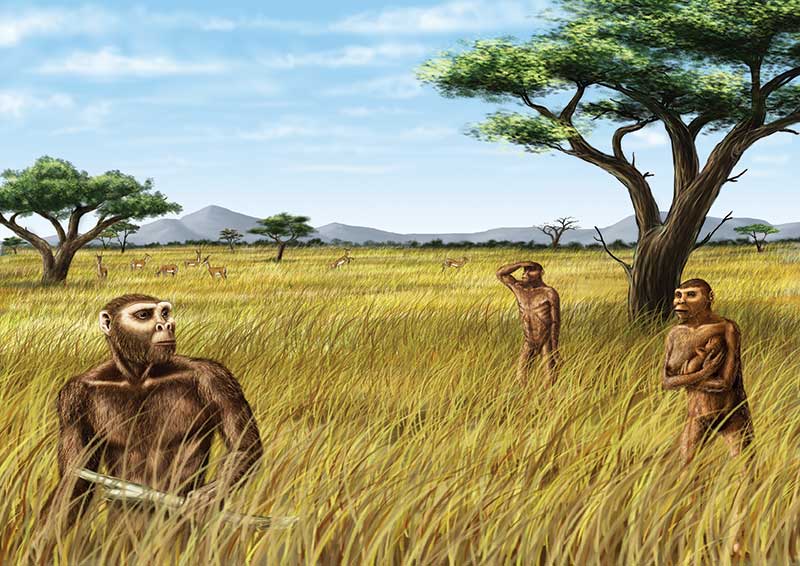
Early modern human evolution, however, remains an area of active debate and research. Initially, there were two opposing theories. The replacement theory argues that all modern humans descend from an ancestral population of Homo sapiens that appeared in Africa about 200,000 years ago and later spread across all continents, replacing other human species that had evolved from an earlier expansion of Homo erectus.
The alternative theory, also known as the multiregional theory, proposes that after the first expansion of Homo erectus around 1.5 million years ago, its descendants evolved together into Homo sapiens, despite being geographically separated. Normally, when a population becomes isolated from others of the same species, it tends to evolve in ways that make it different. However, the multiregional theory argues that continuous gene flow—that is, ongoing interbreeding between individuals from different populations—kept human populations genetically similar and led to the emergence of a single species. Today, the most widely accepted view is a synthesis of these two ideas. The evidence supports a primarily African origin for modern humans, combined with a small percentage of genetic inheritance from other human species.
🤷♂️ The Mitochondrial Eve Theory
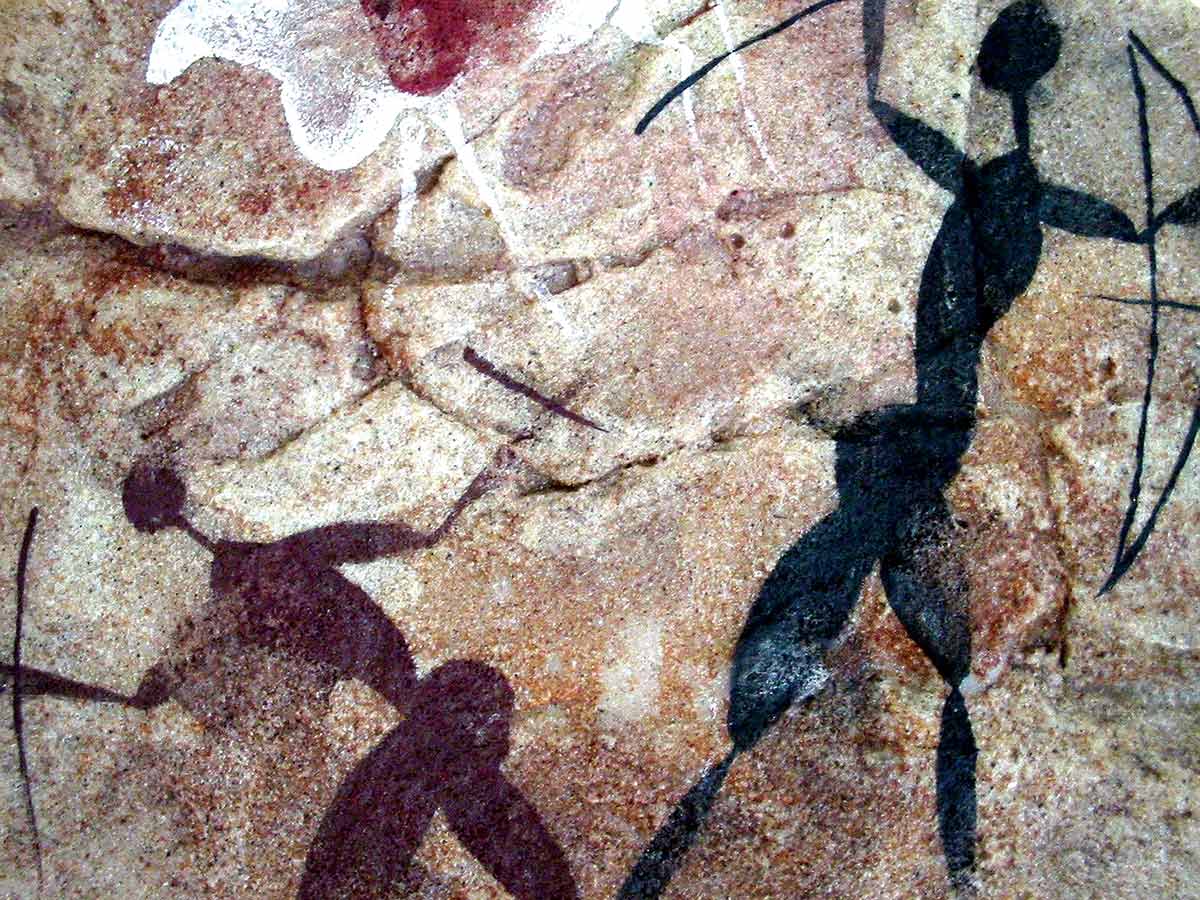
Mitochondrial DNA is particularly useful for studying lineages and building family trees. In 1987, a group of researchers proposed that the mitochondrial genetic diversity of all modern humans could be traced back, by following evolutionary lines backward in time, to a single woman who lived in Africa about 200,000 years ago. This does not mean that only one woman existed at that time. Rather, it supports the theory of an African origin for Homo sapiens, followed by an expansion across the planet slightly less than 100,000 years ago.
WRITTEN BY the ISTF Team
Pictures & Illustrations credits
(1) Thanx, ©sxc.hu; Steven Foley, ©iStock.com
(3) Científica con muestra ADN / D-Keine, ©iStock.com
(4) CSI, Crime Scene Investigation / © CBS
(5) Detención policial / © Michal Zacharzewski
(7) Dinousaurios: Micropachycephalosaurus (izquierda) y Eoraptor (derecha) / Oriol Massana
(8) Ice Age 2 / © Twentieth Century Fox
(10) Arte rupestre / © Reinhardt Hoft
(11) Homo sapiens / Oriol Massana






Leave a Reply