
El Niño
Causes, Consequences, and Its Impact on the Global Climate
El Niño is a recurring disruption of the ocean-atmosphere system that influences weather patterns across the globe. It can trigger floods, droughts, wildfires, and changes in marine ecosystems. Its effects have been so profound that some researchers believe it may even have contributed to the rise and decline of ancient civilizations along the coast of Peru.
4 de diciembre de 2024

The coast of Peru is dotted with the remains of magnificent pyramids. Archaeologists have discovered that these mysterious monuments, reminiscent of those in Egypt, were built between 3,000 and 6,000 years ago. At the end of this period, however, they were suddenly abandoned. What happened to the civilization that had gone to such great lengths to construct them? Daniel Sandweiss, a geologist at the University of Maine, USA, argues that their decline was linked to El Niño, a phenomenon with far-reaching consequences for weather patterns around the world. El Niño still occurs today and continues to be closely monitored by meteorologists.
El Niño and the Ancient Civilizations in Peru
The American archaeologist Daniel H. Sandweiss and other researchers have studied how climate changes influenced the ancient civilizations along the Peruvian coast. Their research indicates that the frequency of El Niño events has varied considerably over the millennia. Around 6,000 years ago, these events were less frequent than they are today, but about 3,000 years ago, they began occurring about as often as they do now.
Scientists have found evidence of major floods and other natural disasters at ancient settlements. These events may have contributed to the abandonment of some cities. However, the societies of that time also learned to adapt to environmental challenges by building canals and changing their ways of life.
“El Niño”: The Name of a Global Phenomenon
Fishermen in Peru and Ecuador have long known that fishing can become difficult around Christmas. Every few years, the ocean water becomes unusually warm and fish populations decline. Because this event occurs near the celebration of the birth of Jesus, fishermen named it El Niño, meaning “the Christ Child” in Spanish.
Scientists also refer to this event as the Southern Oscillation, and today the combined term ENSO (El Niño–Southern Oscillation) is widely used. ENSO occurs, on average, every two to seven years, typically reaching its peak between December and March. It involves much more than unusually warm waters off the coast of South America; it represents a large-scale disruption of the coupled ocean-atmosphere system. Its effects can even be felt in southern Spain and other parts of the world.
Winds and Currents
El Niño begins far from Peru and Ecuador, on the opposite side of the Pacific Ocean, in tropical regions near Australia and Indonesia. Under normal conditions—sometimes called neutral conditions—the trade winds push enormous amounts of warm surface water westward across the Pacific. As a result, sea level in Indonesia is about half a meter higher than along the coast of Peru. At the same time, a process known as upwelling occurs along the western coast of South America. The combined effects of the trade winds and Earth’s rotation bring deep, cold water to the ocean surface.
Together, the trade winds and upwelling create a difference in sea-surface temperature of as much as 8 °C between Peru and Indonesia. The warmer waters near Asia cause air to rise, promoting cloud formation and abundant rainfall, while the Pacific coast of South America remains comparatively dry.
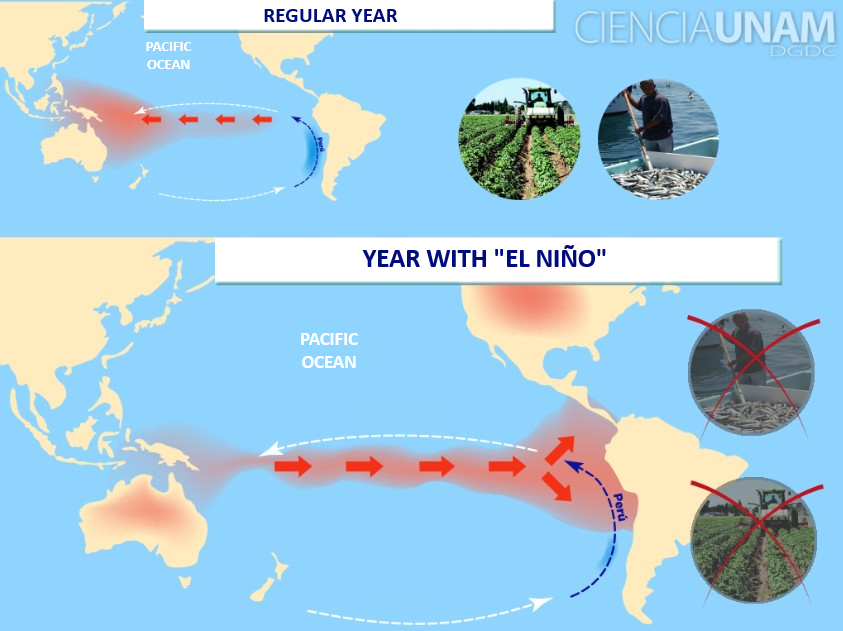
El Niño also affects the agricultural and fishing sectors in Mexico.
How El Niño Affects the Ocean and Atmosphere
El Niño dramatically disrupts these normal conditions. Changes in atmospheric pressure weaken or even halt the trade winds, initiating what scientists call the warm phase of ENSO. Warm waters that had accumulated in the western Pacific begin moving eastward and reach the coast of South America within six months.
Meanwhile, sea-surface temperatures near Asia become significantly cooler. The shift in atmospheric pressure also causes cloud systems and rainfall to migrate eastward toward the Americas. This large-scale reorganization of the atmosphere is known as the Southern Oscillation, which occurs periodically. One of the main signs that an El Niño event is underway is that the water across a large area of the equatorial Pacific becomes warmer than usual for several months.

Map of anomalous ocean surface temperatures during the maximum expansion of the 1982-83 El Niño event in January 1983.
Would You Like to Explore These Topics in the Classroom?
A History of Famine, Fires, and Disease
The cold waters that rise from the depths along the coasts of the Americas are rich in nutrients. These nutrients support marine ecosystems and sustain the fisheries on which many local communities depend. During El Niño events, however, warmer waters and changes in salinity disrupt these ecosystems, affecting fish populations, seabird communities, and even the health of coral reefs.
At the same time, increased rainfall along the Pacific coast of the Americas can cause severe flooding and tropical storms. In 1991, Peru experienced a cholera epidemic. The strain responsible for the outbreak was the same one that had circulated in Indonesia for years. Some researchers have suggested that the bacterium may have crossed the Pacific with plankton carried by ocean currents associated with El Niño, while warmer temperatures and flooding helped the disease spread.
The effects of El Niño are no less significant on the other side of the Pacific. Variations in monsoon rainfall have been linked to the Southern Oscillation. At the same time, when El Niño causes the coasts of Asia to become drier, severe droughts and devastating wildfires can occur, such as those that have affected Australia.
In 1997 and 1998, the fires that swept through Indonesia and the Amazon released large amounts of carbon dioxide into the atmosphere and reduced the area of vegetation capable of converting this gas into oxygen. El Niño disrupts atmospheric conditions on a global scale, affecting agriculture and water resources. According to Peru’s National Meteorological Institute, this phenomenon is also associated with the droughts that affect southern Spain and North Africa, causing damage estimated at up to 200 million euros.

Nurses assisting a patient with cholera.

Forest wildfire.
A Necessary Evil
Although El Niño can cause severe natural disasters, it is a phenomenon that is part of the normal functioning of Earth’s climate system. During these events, heat is redistributed across the Pacific Ocean, and winds and rainfall patterns change in many parts of the world. Over thousands of years, many ecosystems have adapted to these natural variations.
Some researchers believe that El Niño helped animals colonize the islands of the central Pacific, something that would have been impossible if the trade winds had never varied in intensity. Others suggest that changing wind patterns allowed Polynesian peoples to reach islands near Tahiti.

Ancestral ceremony of the Polynesian people.
El Niño: Mysterious Causes
Several theories attempt to explain why this phenomenon occurs in the Pacific Ocean but not in the Atlantic. The Pacific is much wider, allowing large masses of warm water to accumulate in its western region—something that does not happen in the Atlantic. In addition, the Pacific contains equatorial waves: slow movements of water capable of transporting heat and currents over long distances. Scientists are also investigating how global warming may affect El Niño. Although they do not yet know for certain whether it will make these events more intense or more frequent, climate models indicate that changes in rainfall associated with the phenomenon could become more pronounced over the coming decades. This means that some regions could experience more extreme droughts and floods.
“It is important to state that we do not know why El Niño begins; we do not have an explanation for this phenomenon,” says William S. Kessler of the U.S. National Oceanic and Atmospheric Administration (NOAA).
“In any case, we must remember that El Niño is a natural part of our climate system, just as summer and winter are.”
Would You Like to Explore These Topics in the Classroom?
This article was produced in collaboration with Science Bits, the educational materials developed by the project served as the basis for both this article and a selection of classroom activities on El Niño.
Teachers who would like to receive these resources can simply complete the form below and will receive an email with the materials.
*Having trouble with the form? Please contact us [email protected]
WRITTEN BY Michele Catanzaro
Recommended Reading
- Poynting, M. and Stallard, E. (2026, june 11th).What is El Niño and why could it mean record temperatures?. BBC news.
- Feely, Richard A y McPhaden, Michael (2020, 9 de noviembre). El Niño Southern Oscillation in a Changing Climate. NOAA Research
- How will climate change change El Niño and La Niña?, NOAA research (Noviembre, 2020)
- El Niño Pacific Marine Environmental Laboratory
Pictures & Illustrations credits
- El Niño impacts on Mexico – Ludwika López, Universidad Nacional Autónoma de México.
- Map of temperatures – Maulicioni, Wikipedia.org.
- Forest wildfire – USDA, Flickr.com



Leave a Reply