
Asteroids: The Threat from Space
Every year, tens of thousands of meteoroids enter Earth’s atmosphere. Most are very small—about the size of a pebble—and burn up before reaching the ground. Occasionally, however, these objects are much larger. Some asteroids can be several kilometers across. The most famous example is the asteroid impact that contributed to the extinction of the dinosaurs about 66 million years ago. Today, however, we are not entirely out of danger. For example, in July 2025, astronomers detected the asteroid 2025 OW, measuring approximately 60 to 67 meters across. NASA monitored and photographed the asteroid during its approach to Earth, which in this case posed no threat.
4 de diciembre de 2024

What Is an Asteroid?
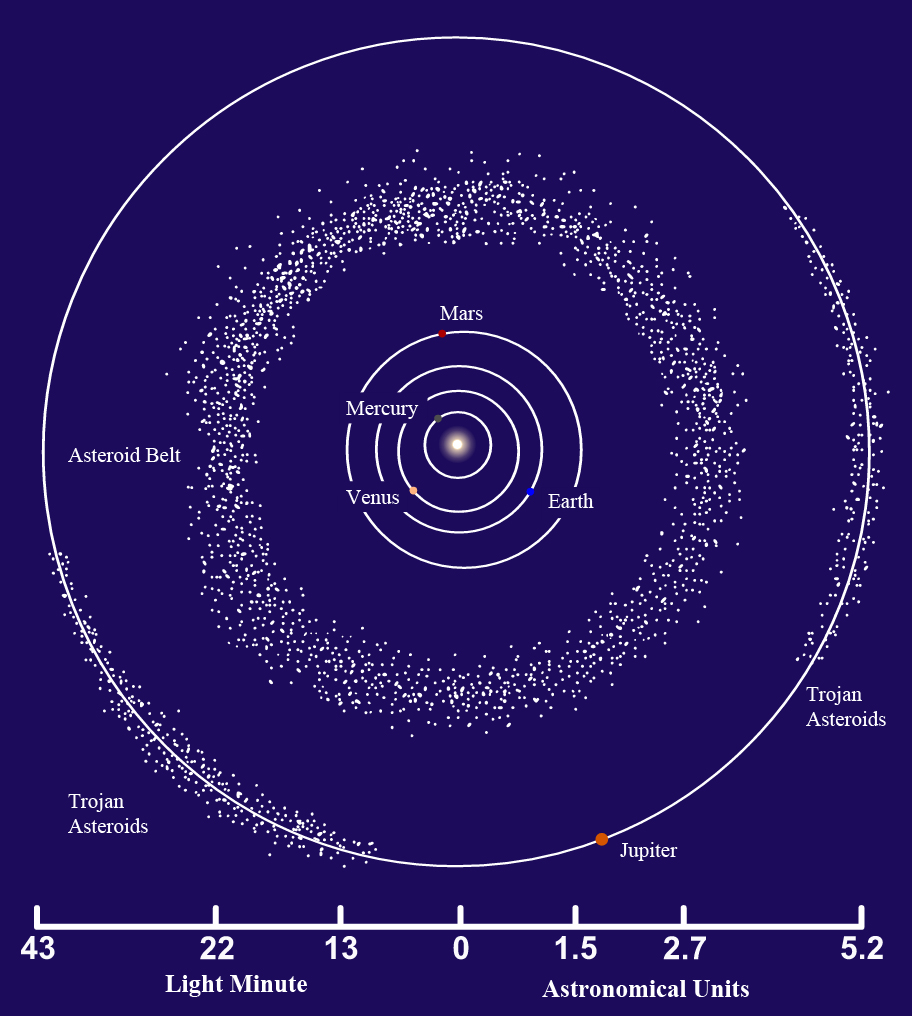
Asteroids are rocky objects that formed during the creation of the solar system and now travel through space, generally orbiting a star or a planet. Most asteroids are found in the main asteroid belt, located between Mars and Jupiter, where they orbit the Sun.
Asteroids vary greatly in both shape and composition. Most are too small to have the spherical shape characteristic of planets, which is produced by the force of their own gravity. Many are also covered with impact craters. The largest asteroids are about 900 kilometers in diameter, while the smallest are just over 50 meters across.
The distance from the Sun at which an asteroid formed played a major role in determining its composition. Asteroids that formed in regions exposed to higher temperatures generally contain greater amounts of iron in their interiors. Based on their composition, the most common asteroids in the solar system are C-type asteroids. These have a very dark appearance, similar to charcoal, because they contain large amounts of carbon-rich material along with rock and metal. Other major groups include S-type asteroids, composed mainly of silicate minerals and nickel-iron, and M-type asteroids, which are primarily metallic.
Asteroids or Meteorites?
Besides asteroids, there are other small objects in space known as meteoroids. Meteoroids are smaller than asteroids and are generally less than 50 meters in diameter. Many enter Earth’s atmosphere every day.
You have probably seen one yourself. When a meteoroid enters Earth’s atmosphere at high speed, friction with the air causes it to heat up and glow, creating a brief streak of light across the night sky. These glowing trails are known as shooting stars. In most cases, friction with the atmosphere causes the meteoroid to burn up completely before reaching the ground. However, if part of the object survives its passage through the atmosphere and lands on Earth’s surface, that remaining fragment is called a meteorite.
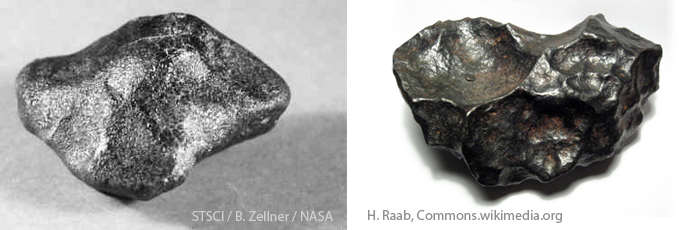
Vesta asteroid
Fragment of the asteroid Vesta that fell in Spain in May 2007.
Gibeon meteorite
Fragment of the Gibeon meteorite, weighing 4.5 kg and measuring 19 cm across. It was found in Australia in 1991.
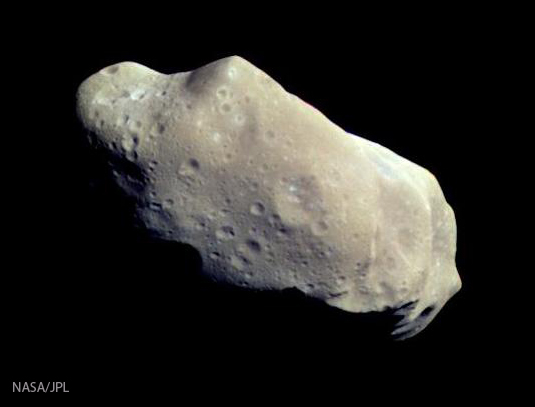
Ida asteroide
Video from the “The Solar System” unit, provided by Science Bits, the science education project.
What we commonly call shooting stars are actually meteoroids entering Earth’s atmosphere and burning up due to friction with the air. The fragments that survive and reach Earth’s surface are called meteorites.
Where Are Asteroids Located?
A region between Mars and Jupiter contains vast numbers of asteroids orbiting the Sun. Known as the main asteroid belt, it is home to most of the asteroids in the solar system. The belt contains millions of asteroids, many more than 1 kilometer in diameter. Yet despite their large numbers, the combined mass of all the asteroids in the belt is less than 6% of the Moon’s mass. Their orbits around the Sun are generally stable, although some are occasionally deflected and end up crossing the paths of planets.
Scientists believe the asteroid belt formed because of Jupiter’s enormous gravitational influence. During the early history of the solar system, Jupiter’s gravity prevented the material in this region from coming together to form a planet. Not all asteroids, however, are found in the main belt. Some share a planet’s orbit around the Sun and are known as Trojan asteroids. Because Jupiter has the strongest gravitational pull of any planet in the solar system, it also has the largest population of Trojan asteroids. Farther out, between the giant planets, there are other small bodies known as Centaurs.
Finally, some asteroids belong to a group known as Near-Earth Objects (NEOs). These objects are of particular interest because their orbits bring them close to Earth. Since some NEOs cross Earth’s orbital path, astronomers monitor them carefully to assess any potential risk of future impacts.
Meteorites and Planetary Scars
When an asteroid collides with a planet, it creates an impact crater. The size of the crater depends on several factors, including the asteroid’s size, composition, speed, and angle of impact. Even an object only a few dozen meters across can release more energy than an atomic bomb.
Today, thousands of meteoroids enter Earth’s atmosphere every year, although only a small fraction reach the ground as meteorites. This may seem like a large number, but impacts are far less common than they were during the early history of the solar system. At that time, planets were subjected to relentless bombardment by asteroids and other space debris. The Moon’s heavily cratered surface is a lasting reminder of this era of intense impacts.
The answer is erosion, a process that is almost absent on the Moon. Erosion is the gradual wearing away of Earth’s surface by wind, water, ice, and living organisms. Over long periods of time, these forces can erase the scars left by impacts. For example, given hundreds of millions of years, erosion could wear down a mountain range such as the Pyrenees until it became a broad plain.

Barringer crater in Arizona (USA) is 1,200 m in diameter and was caused by a fairly large meteorite impact about 20,000 years ago. It’s one of the few recent craters to have survived the fierce effects of erosion on the Earth’s surface. In contrast, thousands of craters remain visible on the Moon, preserved by its lack of erosion.
Impacts on Earth and Their Effects
During the earliest stages of Earth’s history, impacts from asteroids were extremely common. Over time, these collisions became less frequent, allowing conditions suitable for life to develop. Scientists believe that the last impact powerful enough to boil away all of Earth’s oceans occurred about 4 billion years ago. Since then, water has remained in liquid form on the planet’s surface—a key requirement for the emergence and survival of life as we know it.
Impacts did not stop, however. The most famous occurred about 65 million years ago near what is now the Yucatán Peninsula in Mexico. This event contributed to the extinction of the dinosaurs and many other species. The impact released an enormous amount of energy—more powerful than dozens of thermonuclear bombs combined—ejecting vast quantities of dust and vapor into the atmosphere. These materials blocked sunlight for an extended period.
Smaller asteroids continue to approach and occasionally strike Earth today. For this reason, astronomers constantly survey the night sky, tracking objects whose orbits bring them close to our planet. In recent years, scientists have paid particular attention to an asteroid that will make a very close approach to Earth in 2029. This is not science fiction—it is a reminder of the importance of monitoring near-Earth objects.
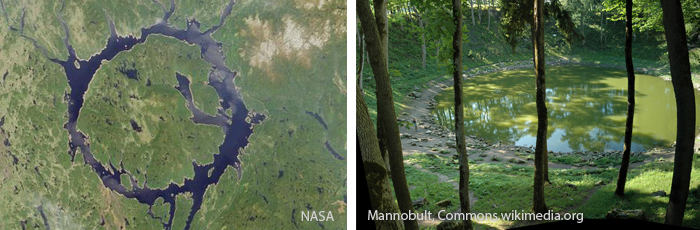
The Manicouagan Lake in Quebec, formed 212 million years ago when a large meteorite collided with Earth.
In Kaali, Estonia, nine craters were created by the impact of a single meteorite that split into several fragments before reaching the surface. These craters, estimated to have formed more than 9,900 years ago, remain a subject of scientific study today.
The most famous asteroid impact is the one believed to have contributed to the extinction of the dinosaurs. This event occurred near what is now Mexico about 65 million years ago.

The Mysterious Tunguska Incident
At 7:17 a.m. on June 30, 1908, a tremendous explosion occurred over Tunguska, a remote forested region of central Siberia in Russia. The blast flattened trees and scorched forests across more than 2,000 square kilometers. Witnesses reported being thrown to the ground by the shock wave, and windows shattered as far as 400 kilometers away. The conductor of the Trans-Siberian Railway reportedly stopped the train, fearing that it had derailed.
The energy released by the explosion is estimated to have been between 10 and 15 megatons of TNT—hundreds of times greater than the energy released by the atomic bomb dropped on Hiroshima.
Curiously, no impact crater was ever found. Scientists now believe that the explosion occurred about 8 kilometers above the ground when a meteorite approximately 80 meters across disintegrated in the atmosphere. The meteorite may have been a fragment of a comet, composed largely of ice and dust. Similar events have been observed in modern times.
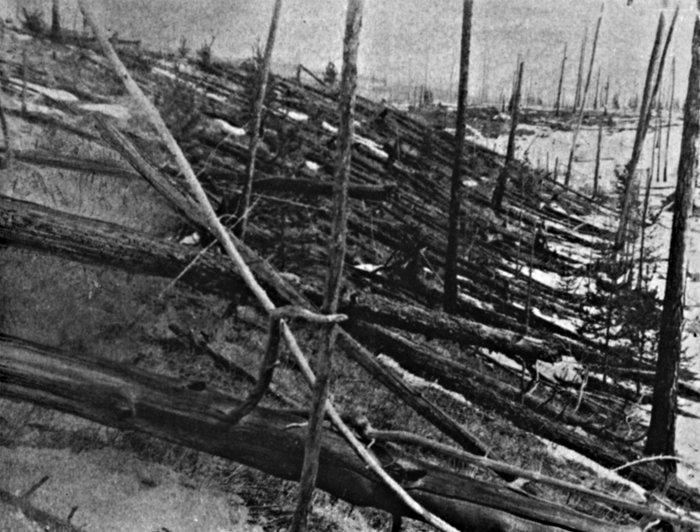
The Tunguska event was a huge blast that occurred near the Stony Tunguska River, in Yeniseysk Governorate (now Krasnoyarsk Krai), Russia.
An Asteroid Approaches Earth
Currently, about 10,000 known objects roaming through space are classified as Near-Earth Objects (NEOs). When one of these bodies comes within 0.05 astronomical units (about 7.5 million kilometers) of Earth and is large enough to pose a significant threat, it may be classified as a Potentially Hazardous Asteroid (PHA). The name is fitting: an impact from one of these objects could have devastating consequences for human civilization. To date, astronomers have identified roughly 2,400 potentially hazardous asteroids. One of the most famous is Apophis, which caused considerable concern when it was discovered.
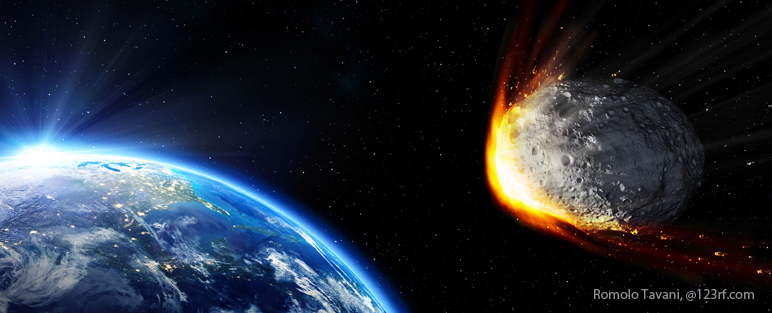
Initially, scientists believed it would not collide with Earth, but that it could come close enough to cause significant damage. The concern sparked efforts to develop strategies for diverting the asteroid. Fortunately, more precise calculations have confirmed that Apophis poses no threat to Earth.
Currently, the asteroid considered the greatest risk is Bennu. However, the probability of Bennu impacting Earth in the year 2182 is just 0.037%. While no asteroid currently poses a serious threat, it is still wise to remain prepared for such possibilities. After all, an asteroid large enough to cause significant damage is thought to strike Earth about once every 40,000 years.
The Moon is believed to have formed when a massive asteroid struck Earth, ejecting a fragment that eventually became trapped in orbit around the planet.
Asteroids or Planets?
Some rocky bodies in the solar system are too large to be classified as asteroids but not large enough to qualify as planets. Pluto, located in the outer reaches of the solar system, is a prime example. Until recently, Pluto was classified as a planet, even though it is smaller than Earth’s Moon. Astronomers addressed this issue by introducing a new category: dwarf planets. In August 2006, Pluto, along with Ceres and Eris—both previously classified as asteroids—was officially designated a dwarf planet.

Ceres
Pluto
Dwarf planets do not exert enough gravitational influence on nearby objects to clear their orbital paths of other material. Unlike classical planets, which dominate their orbits through gravity, dwarf planets share their orbital regions with other bodies.
Was Life Hitching a Ride on Meteorites?
Is it possible that we are all aliens? This intriguing question lies at the heart of panspermia, a scientific hypothesis suggesting that life may have arrived on Earth via meteorites. Although the theory is not widely accepted, it has received some experimental support in recent years. Jacek Wierzchos, a researcher at the Museo Nacional de Ciencias Naturales—CSIC (Spain), took part in one such experiment.
In 2007, a sample of lichens and microorganisms was sent into space aboard the Photon-M3 spacecraft, launched from Baikonur, Kazakhstan. When the spacecraft returned to Earth two weeks later, the organisms were still alive. “If organisms can survive a trip through space, we cannot rule out the possibility that life reached Earth from space,” Wierzchos explained.
Even if life itself did not arrive on Earth inside meteorites, a large amount of organic matter—the type of material that living organisms are made of—has certainly reached Earth and continues to do so. This material has been carried inside meteorites since the formation of the planet.

Image of the 43 scientific and technological devices contained in the Photon M3 capsule.
Explore these and many other topics about the formation of the solar system and the bodies that make it up in the secondary education materials developed by Science Bits, an educational project based on research into how people learn and supported by the International Science Teaching Foundation (ISTF).
WRITTEN BY Héctor Ruiz Martín
Pictures & Illustrations credits
- Meteorite approaching Earth – Johan Swanepoel @123rf.com.
- Ida asteroid – NASA-JPL.
- Vesta asteroid – STSCI, B- Zellner, NASA.
- Gibeon meteorite – H. Raab, Commons Wikimedia.org.
- Asteroid belt – NASA-JPL.
- Barringer crater – D. Roddy (U.S. Geological Survey), Lunar and Planetary Institute.
- Manicouagan Lake, Quebec – NASA.
- Kaali craters, Estonia – Mannobult, Commons Wikimedia.org.
- Dinosaurs – Esteban De Armas @123rf.com
- Tunguska event – Commons Wikimedia.org.
- Asteroid approaching Earth – Romolo Tavani, @123rf.com
- Ceres – Justin Cowart
- Pluto – NASA, Johns Hopkins University, Applied Physics Laboratory, Southwest Research Institute.
- Photon M3 – ESA – S. Corvaja 2007






Very nice and informative. Please send more information on meteorites and other objects. Thank you
Great learning about how earth has evolved and how it could have came together over time. How small earth is and how gravity of other plants pull on each to how all in orbits.